
Pressure Vessel Engineering: History, Mechanics, ASME Standards & the Future
Most people never think about pressure vessels — until one fails. Then everyone thinks about them. Inside a steel wall no thicker than your thumb, pressures of hundreds or thousands of PSI are held at bay by physics, metallurgy, and a century of hard-won engineering rules. This guide tells that whole story: the disasters that made the rules necessary, the science that makes the rules work, and the innovations pushing the boundaries of what's possible.
What Is a Pressure Vessel?
At its most basic, a pressure vessel is a closed container built to hold a fluid or gas at a pressure that differs significantly from whatever's outside it. That sounds simple. But walk through a refinery and look up — the towers stretching thirty metres into the sky, the tangled web of piping, the squat horizontal drums catching condensate — almost all of it qualifies. So does the autoclave in a hospital sterilization room. So does the little carbon-fibre tank in a Formula 1 car's HANS device.
The formal threshold is 15 psi (roughly 100 kPa) above ambient pressure. Below that, you're building a tank. Above it, the full weight of international engineering codes kicks in — and for good reason. A pressurised vessel stores enormous potential energy in a very compact space. When it lets go, it doesn't just leak. It explodes.
The engineering challenge in a single sentence — Contain the pressure completely — without yielding, cracking, or fatiguing — across 20 to 40 years of continuous industrial use.
The Disasters That Wrote the Rulebook
Modern engineering codes aren't invented in universities. They're forged in wreckage. Every clause in the ASME BPVC has a backstory — and the most important backstories involve mass casualties.
The Sultana (1865)
The deadliest maritime disaster in American history wasn't a sinking — it was a boiler explosion. On the night of April 27, 1865, the sidewheel steamboat Sultana was pushing upriver through flooded Mississippi waters, packed with more than 2,000 recently paroled Union soldiers desperate to get home. Her legal capacity was 376.
One of her four boilers had a known crack. The repair? A hasty patch, slapped on to avoid losing a lucrative government transport contract. Under the strain of an overloaded hull against a powerful spring current, three boilers ruptured simultaneously. The explosion threw men hundreds of feet into the dark river. The fire that followed took the rest. Between 1,195 and 1,800 people died — more than on the Titanic — because someone decided a shortcut was worth the risk.
The Grover Shoe Factory (1905)
Forty years later, the lesson still hadn't been learned. On March 20, 1905, a neglected backup boiler at the R. B. Grover Shoe Factory in Brockton, Massachusetts, let go with enough force to rocket itself through three floors and the roof, bringing the wooden structure down around the workers inside. Fifty-eight people were killed. One hundred and fifty more were injured.
The public fury that followed was decisive. Massachusetts drafted the first legally enforceable boiler construction rules in 1907. But the problem with state-by-state regulation quickly became obvious: a boiler legal in Massachusetts might be banned in Ohio. Industry needed one standard. It got one in 1915.
The ASME BPVC: 19,000 Pages of Safety
The American Society of Mechanical Engineers published the first Boiler Code in 1915. Over the next century it grew into the ASME Boiler and Pressure Vessel Code (BPVC) — a living document that now spans more than 19,000 pages, updated on a two-year revision cycle, and adopted by regulatory bodies in over 100 countries. It is the closest thing the engineering world has to a universal law of contained pressure.
Section VIII: The Pressure Vessel Engineer's Bible
For most working engineers, the relevant volume is Section VIII, which governs the design, fabrication, inspection, and certification of unfired pressure vessels. It comes in three divisions, each calibrated to a different pressure regime and design philosophy:
| Division | Pressure Range | Design Method | Typical Use |
|---|---|---|---|
| Division 1 | Up to 3,000 psi | Design by Rule (formula-based) | Refineries, utilities, chemical plants |
| Division 2 | 3,000–10,000 psi | Design by Analysis (FEA required) | High-pressure reactors, heat exchangers |
| Division 3 | Above 10,000 psi | Elastic-plastic analysis + fatigue tracking | Hydraulic presses, deep-sea equipment |
Why three divisions? Higher pressure demands more rigorous analysis, but also allows thinner walls and lighter vessels — which is why the investment in Division 2 FEA often pays off at scale. Division 3 is reserved for applications where getting it wrong is simply not an option.
The Physics: Hoop Stress and Longitudinal Stress
Before you can design a vessel that won't fail, you need to understand exactly what the pressure is trying to do to the walls. For a cylindrical thin-walled vessel — one where the wall thickness is less than a tenth of the internal radius — internal pressure creates two distinct, predictable stress states.
Hoop Stress (Circumferential Stress)
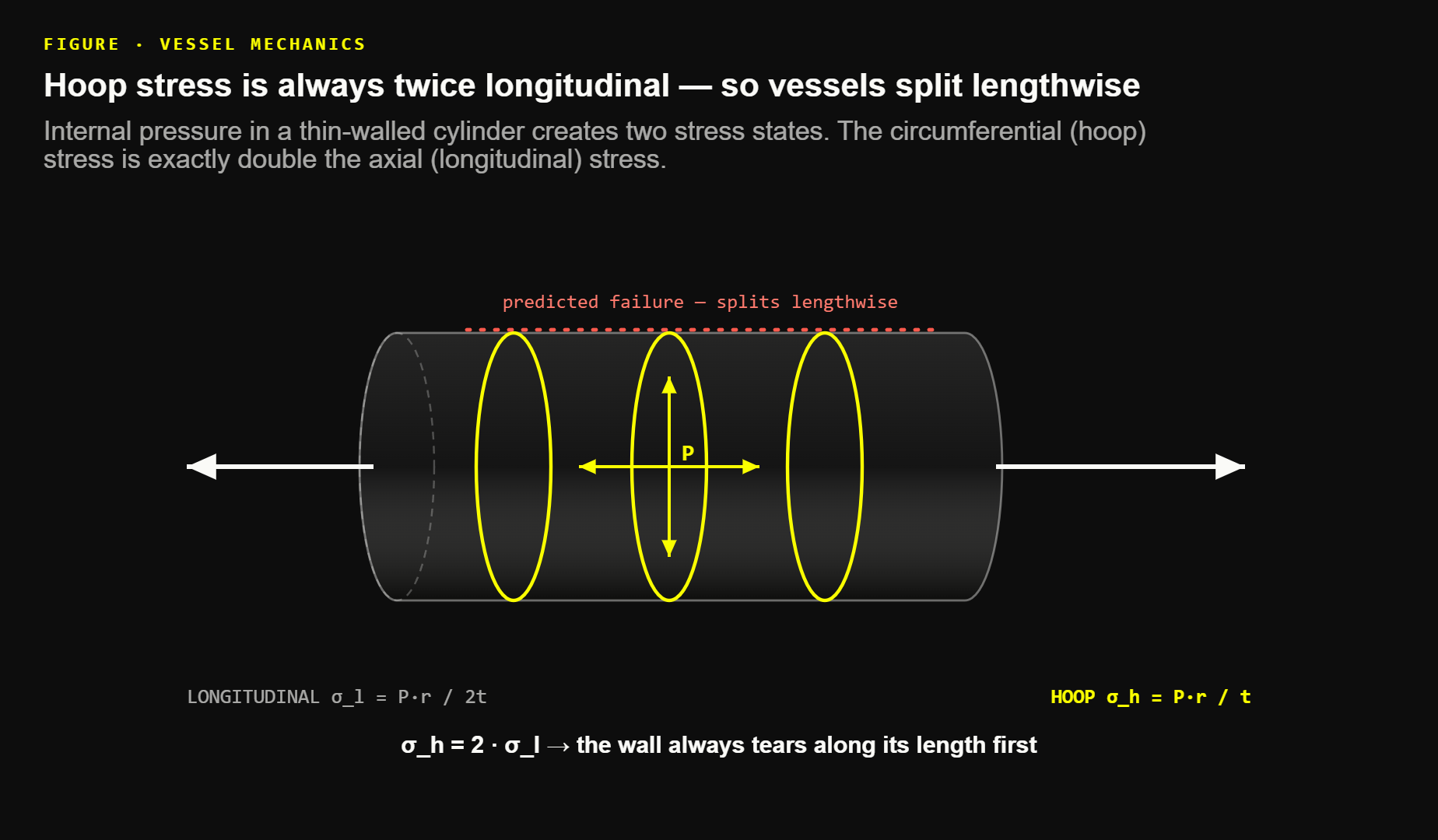
Imagine the pressure inside the cylinder pushing outward in every direction. The force trying to split the cylinder open along its length — like a seam bursting on an overstuffed sausage — is called hoop stress. It is the dominant design driver and is calculated as:
where P is internal pressure, r is the internal radius, and t is the wall thickness.
Longitudinal Stress (Axial Stress)
The same pressure also pushes against the end caps, trying to blow them off. This axial force creates longitudinal stress along the vessel wall — and it is always exactly half the hoop stress:
This 2:1 ratio has a critical practical implication: when a cylindrical vessel fails, it almost always splits lengthwise — not end-to-end. The failure mode is predictable because the physics is predictable. Engineers use that predictability to design for controlled failure and safe pressure relief.
There's a subtler implication too. Hoop stress scales directly with radius. Double the vessel diameter at the same pressure, and the wall stress doubles — even though nothing else changed. This is why high-pressure gas storage systems often use bundles of small cylinders rather than one large tank.
Materials, Failure Modes & NDE Testing
A pressure vessel is only as strong as its weakest point — and that point is almost always a weld seam, a microscopic inclusion in the steel, or a stress concentration around a nozzle. Getting the stress formulas right is necessary but not sufficient. You also need to understand how materials fail over time, and how to find hidden flaws before they find you.
The Three Failure Modes Every Engineer Must Know
| Failure Mode | Mechanism | Key Risk Context |
|---|---|---|
| Brittle Fracture | Metal loses ductility at low temperature and fractures without warning | Cold climates, cryogenic service, carbon steels below transition temperature |
| Fatigue | Micro-cracks grow at stress concentrations through repeated load cycles | Vessels pressurised and depressurised thousands of times over their service life |
| Creep | Slow permanent deformation under sustained stress at high temperature | Steam generation, petrochemical reactors, power plant equipment above 400°C |
Non-Destructive Examination (NDE)
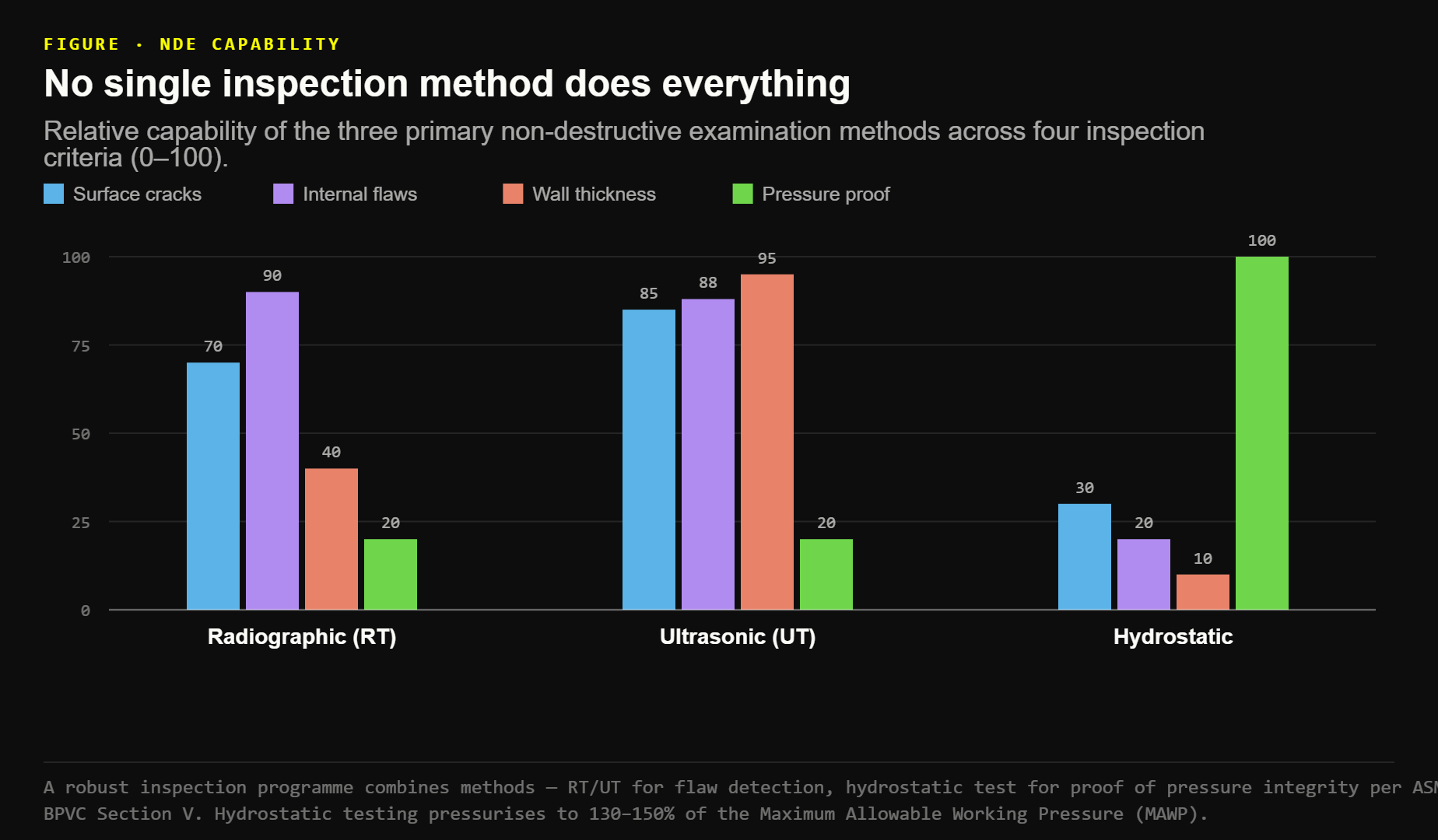
ASME BPVC Section V requires every completed vessel to be examined using methods that reveal hidden flaws without damaging the component. The three primary tools in the inspector's arsenal are:
- Radiographic Testing (RT) — Industrial X-rays or gamma rays image the interior of weld seams, exposing voids, porosity, inclusions, and cracks invisible from the surface. It remains the gold standard for weld inspection in critical applications.
- Ultrasonic Testing (UT) — High-frequency sound waves pass through the vessel wall and reflect off internal boundaries. The reflected signal maps wall thickness to millimetre precision and detects planar defects that X-rays sometimes miss.
- Hydrostatic Testing — The final proof before service. The vessel is filled entirely with water — chosen because water, unlike gas, won't expand explosively if the vessel fails — then pressurised to 130–150% of its Maximum Allowable Working Pressure (MAWP). Survive that, and you're cleared for deployment.
The Future: Composite Vessels and Smart Sensors
For stationary industrial applications, heavy steel is still king — it's robust, cheap, and well understood. But the moment weight enters the equation, steel's limitations become critical. Aerospace, hydrogen fuel infrastructure, and automotive engineering have spent the last three decades solving a problem steel can't: how do you safely contain extreme pressure in something light enough to actually move?
Composite Overwrapped Pressure Vessels (COPVs)
The answer is the Composite Overwrapped Pressure Vessel, or COPV. The concept is elegant: a thin metallic or polymer liner provides the fluid barrier, while a shell of carbon fibre or Kevlar — wound under tension and saturated in epoxy — provides the structural strength. The composite carries the load; the liner stays sealed. A COPV rated for 10,000 psi can weigh a fraction of what an equivalent steel tank would.
COPVs are now standard in spacecraft (SpaceX uses them on Falcon 9 second stages), hydrogen fuel cell vehicles, compressed natural gas systems, and the self-contained breathing apparatus carried by firefighters. The tradeoffs — higher unit cost, more complex inspection requirements, different failure signatures — are well understood and worth it for the applications that justify the weight saving.
Structural Health Monitoring: Predicting Failure Before It Happens
The next frontier isn't in materials — it's in intelligence. Engineers are embedding acoustic emission sensors and fibre-optic strain gauges directly into vessel walls during manufacture. These systems listen continuously for the characteristic sound of a propagating micro-crack, track strain distribution in real time, and flag anomalies long before they approach critical thresholds.
The implication is a shift from scheduled inspection to condition-based monitoring: instead of pulling a vessel offline every fixed number of years regardless of its actual condition, you service it when the data says to. Less downtime. Fewer unnecessary interventions. And — most importantly — far earlier warning of the failures that actually matter.
Where COPVs are already flying — SpaceX Falcon 9 second stage · Toyota Mirai hydrogen tank · Boeing 787 emergency O₂ systems · Firefighter SCBA cylinders · NASA Orion crew module pressurisation
The formula for hoop stress is just four characters: Pr/t. But behind it sits a century of disasters, public outrage, regulatory reform, metallurgical research, and the quiet, unglamorous work of engineers who made sure the numbers were right before the vessel left the factory floor. That's what pressure vessel engineering actually is — not just physics, but the accumulated institutional memory of every time the physics was ignored and people died.
Whether you're selecting a Division for a new design, overseeing an NDE programme, or evaluating COPVs for a weight-critical application, the foundation is the same: understand the physics, follow the code, verify the welds, and never treat a pressure boundary as an acceptable place to cut corners.
Field notes, monthly
New worked examples and code explainers. No marketing drip.